o c e a n i a

| home |

| africa | america | asia | east asia | europe | OCEANIA | south east asia |

| commemorative | hybrid | polymer | australia |

| a | b | c | d | e | f | g | h | i | j | k | l | m | n | o | p | q | r | s | t | u | v | w | x | y | z |


if you have any comments, please feel free to post them here. all comments are welcome.


"no borrowed scans here nor i cut and pasted from other web sites. all notes displaying here are mine"

Showing posts with label New Zealand. Show all posts

...New Zealand - $10 1990 Commemorative Sequicentennial Anniversary of Waitangi Treaty 1840-1990 (150th Year)

New Zealand
Aotearoa

Reserve Bank of New Zealand (RBNZ est.1934)
Te Putea Matua
Currency : Dollar (NZD)
 

I have waited for more than 30+ years and now decided to see if I can complete this set. Unfortunately, I am still short of two notes.

Here, I have posted 8 out of the 10 notes for the 1990 $10 commemorative notes celebrating the 150th year of the signing of the Treaty of Waitangi (1840-1990). These notes were first released for circulation on 14.08.1992. This is the first time that the Reserve Bank of New Zealand has issued a legal tender banknote commemorating a historical event in the country. 

Back in the early 90s, this note was marketed in Australia by the Royal Australian Mint, and I recall, the 2-in-One Uncut sheets were made available but I cannot remember if other uncut sheets were offered too. I am pretty sure that only the uncut sheets were offered and not the single notes. As if not, I would have bought them too. I then purchased the 2-in-One uncut sheet only, as it was selling quite expensive back in the 90s. Since then, I made no attempt to get the rest of the series (single notes and all other prefixes) until now. Despite the hefty price I have paid for these single notes, it does give me some satisfaction that I now have 8 notes in my collection. To buy them separately could cost me even more and it may also be a challenge to find them available for sale in the market too. As you can see, I am still missing the two notes printed with the prefixes of CCC and DDD.

The Treaty of Waitangi (Te Tiriti o Waitangi) was first signed on 06.02.1840 by Captain William Hobson (1795-1842), who represented the British Crown and then by Northern Maori chiefs at Waitangi. The treaty was written in both English and Maori. The Waitangi Treaty is a foundational agreement in New Zealand which established a partnership between the British Crown and Maori chiefs. It is considered as a constitutional document that guides the relationship between the Crown (the British) and Maori. After the initial signing, the document was then traveled all over New Zealand in the next few months to have it signed by all other chiefs in New Zealand. In all, approximately 540 Maori chiefs signed the treaty, including 13 women. Most of them signed on the Maori version of the treaty, with 39 signed on the English version. As per the name of the treaty, Waitangi is located in the northern part and on the right side of North Island and is about 230 km north of Auckland. Waitangi is not a name of a town or city but rather a locality/settlement and is located in the Bay of Islands. The closest town to Waitangi is Paihia, which is connected by a bridge near the mouth of the Waitangi River estuary. Paihia is a very small coastal town with a population of less than 2000 people.

New Zealand was first visited by the Dutch in 1942. In 1769, Captain James Cook arrived on his first of his three voyages. Since then, New Zealand has been visited by explorers, sailors, missionaries and traders. The Treaty of Waitangi dated 06.02.1840 is considered the official date of colonisation of New Zealand by the British. The treaty was intended to create unity between the British and Maori, but different understandings of the two versions and breaches have led to ongoing controversies and disagreements until today. According to the Maori, the treaty grants the Crown/British governance over the land while acknowledging Maori authority, while the English version gives the Crown/British full sovereignty.

A total of 1.0m pieces were printed for this series with 10 prefixes* issued. Each prefix was printed with 100,000 pieces each with the exception of AAA and BBB prefixes. For the AAA prefix, only 96,000 printed but none were originally issued in single notes. For the BBB prefix, a total of 104,000 issued with 19,450 released in a cardboard sleeve as numismatic products and sold for NZ$17.85 per set. In addition to Prefix BBB, Prefix CCC notes were also sold in a cardboard sleeve as well and it was reported that only 500 sets (CCC 000001-CCC 000500) were made available. As the AAA prefix notes were initially sold as uncut sheets, and later those unsold sheets were returned to RBNZ, and then the bank cut these unsold sheets into individual notes and released them back into circulation. If you have got one in single, it could be possible that it came from the uncut sheet not cut by the bank. I have seen a few of these AAA prefix notes offered by dealers here and most of them are just badly cut and you can tell that it was not officially cut by the RBNZ. As for the uncut sheets, so far, I have sighted the sheets of 32, 16, 4 and 2.

Below are the list of prefixes printed for this series:-

AAA - s/n 000001 to 096000 (initially uncut sheets only);
BBB - s/n 000001 to 104000 (19,450 sets in cardboard sleeve);
CCC - s/n 000001 to 100000 (also issued in cardboard sleeve);
DDD - s/n 000001 to 100000;
CWB - s/n 000001 to 100000 (Countrywide Banking Corporation Ltd);
FTC - s/n 000001 to 100000 (Farmers Trading Company Ltd);
MBL - s/n 000001 to 100000 (Mobil Oil Corporation);
RNZ - s/n 000001 to 100000 (Radio New Zealand);
RXX - s/n 000001 to 100000 (Rank Xerox); and
TNZ - s/n 000001 to 100000 (Television New Zealand TVNZ).
 

In addition to the above, 10 pieces were printed with the prefix of NZ* but used as specimen notes only. It was also reported that no replacement prefixes were printed for this series. Whilst we can confirm that the first prefix for this serial is AAA, would you say the last prefix is TNZ, or there is no last prefix as every one printed is just as unique as the others.

Based on the quantity of 1.0m pieces printed, and in my opinion, this is not a large quantity issue especially for the denomination of $10, which is usually a popular denomination circulating in an economy, just like those notes of $1, $2, $5 and perhaps $20 as well. Back in the early 1990s, New Zealand had a population of about 3.30m people and for that and with a quantity of 1.0m is not considered a large issue.

I have waited for more than 30+ years and now decided to see if I can complete this set. 

Here, I have posted 8 notes for the 1990 $10 commemorative notes celebrating the 150th year of the signing of the Treaty of Waitangi (1840-1990). These notes were first released for circulation on 14.08.1992. This is the first time that the Reserve Bank of New Zealand has issued a legal tender banknote commemorating a historical event in the country. 

Back in the early 90s, this note was marketed in Australia by the Royal Australian Mint, and I recall, the 2-in-One Uncut sheets were made available but I cannot remember if other uncut sheets were offered too. I am pretty sure that only the uncut sheets were offered and not the single notes. As if not, I would have bought them too. I then purchased the 2-in-One uncut sheet only, as it was selling quite expensive back in the 90s. Since then, I made no attempt to get the rest of the series (single notes and all other prefixes) until now. Despite the hefty price I have paid for these single notes, it does give me some satisfaction that I now have 8 notes in my collection. To buy them separately could cost me even more and it may also be a challenge to find them available for sale in the market too. As you can see, I am still missing the two notes printed with the prefixes of CCC and DDD.

The Treaty of Waitangi (Te Tiriti o Waitangi) was first signed on 06.02.1840 by Captain William Hobson (1795-1842), who represented the British Crown and then by Northern Maori chiefs at Waitangi. The treaty was written in both English and Maori. The Waitangi Treaty is a foundational agreement in New Zealand which established a partnership between the British Crown and Maori chiefs. It is considered as a constitutional document that guides the relationship between the Crown (the British) and Maori. After the initial signing, the document was then traveled all over New Zealand in the next few months to have it signed by all other chiefs in New Zealand. In all, approximately 540 Maori chiefs signed the treaty, including 13 women. Most of them signed on the Maori version of the treaty, with 39 signed on the English version. As per the name of the treaty, Waitangi is located in the northern part and on the right side of North Island and is about 230 km north of Auckland. Waitangi is not a name of a town or city but rather a locality/settlement and is located in the Bay of Islands. The closest town to Waitangi is Paihia, which is connected by a bridge near the mouth of the Waitangi River estuary. Paihia is a very small coastal town with a population of less than 2000 people.

New Zealand was first visited by the Dutch in 1942. In 1769, Captain James Cook arrived on his first of his three voyages. Since then, New Zealand has been visited by explorers, sailors, missionaries and traders. The Treaty of Waitangi dated 06.02.1840 is considered the official date of colonisation of New Zealand by the British. The treaty was intended to create unity between the British and Maori, but different understandings of the two versions and breaches have led to ongoing controversies and disagreements until today. According to the Maori, the treaty grants the Crown/British governance over the land while acknowledging Maori authority, while the English version gives the Crown/British full sovereignty.

A total of 1.0m pieces were printed for this series with 10 prefixes* issued. Each prefix was printed with 100,000 pieces each with the exception of AAA and BBB prefixes. For the AAA prefix, only 96,000 printed but none were originally issued in single notes. For the BBB prefix, a total of 104,000 issued with 19,450 released in a cardboard sleeve as numismatic products and sold for NZ$17.85 per set. In addition to Prefix BBB, Prefix CCC notes were also sold in a cardboard sleeve as well and it was reported that only 500 sets (CCC 000001-CCC 000500) were made available. As the AAA prefix notes were initially sold as uncut sheets, and later those unsold sheets were returned to RBNZ, and then the bank cut these unsold sheets into individual notes and released them back into circulation. If you have got one in single, it could be possible that it came from the uncut sheet not cut by the bank. I have seen a few of these AAA prefix notes offered by dealers here and most of them are just badly cut and you can tell that it was not officially cut by the RBNZ. As for the uncut sheets, so far, I have sighted the sheets of 32, 16, 4 and 2.

Below are the list of all prefixes printed for this series:-

AAA - s/n 000001 to 096000 (initially uncut sheets only);
BBB - s/n 000001 to 104000 (19,450 sets in cardboard sleeve);
CCC - s/n 000001 to 100000 (also issued in cardboard sleeve);
DDD - s/n 000001 to 100000;
CWB - s/n 000001 to 100000 (Countrywide Banking Corporation Ltd);
FTC - s/n 000001 to 100000 (Farmers Trading Company Ltd);
MBL - s/n 000001 to 100000 (Mobil Oil Corporation);
RNZ - s/n 000001 to 100000 (Radio New Zealand);
RXX - s/n 000001 to 100000 (Rank Xerox); and
TNZ - s/n 000001 to 100000 (Television New Zealand TVNZ).
 

In addition to the above, 10 pieces were printed with the prefix of NZ* but used as specimen notes only. It was also reported that no replacement prefixes were printed for this series. Whilst we can confirm that the first prefix for this serial is AAA, would you say the last prefix is TNZ, or there is no last prefix as every one printed is just as unique as the others.

Based on the quantity of 1.0m pieces printed, and in my opinion, this is not a large quantity issue especially for the denomination of $10, which is usually a popular denomination circulating in an economy, just like those notes of $1, $2, $5 and perhaps $20 as well. Back in the early 1990s, New Zealand had a population of about 3.30m people and for that and with a quantity of 1.0m is not considered a large issue.

The Reserve Bank of New Zealand also put together the first 1000 sets all with matching serial numbers (#000001 - 001000) for sale to collectors. Report stated that 7 notes with prefixes DDD, CWB, FTC, MBL, RNZ, RXX and TNZ with matching serial numbers were sold as numismatic products. The notes with prefixes of AAA, BBB and CCC were not included. However, I have only six notes with matching serial numbers. These 1000 sets were first released to collectors in July 1990. I wonder if the RBNZ managed to sell all these 1000 sets issued and if not, were there any unsold sets redistributed back as single notes for circulation. The bank, I believe, has a habit of either redistributing unsold numismatic products or destroying them completely to save storage space. Whilst I am not entirely clear as to why the bank printed these unusual six prefixes that each represented a business entity in New Zealand, however, it was believed (according to a dealer) that these companies were involved in the sponsoring for this commemorative $10 series which would allow them to promote their businesses/brands in the country with their business acronym printed on the note as letter prefixes. In terms of how successful these promoting exercises were may not be known unless they have conducted research on this after the release of the notes back then. I honestly doubt anyone would have noticed this unless you are a collector or the employees of these companies involved, as normal people would have care less. Apology for my negative comment as the truth always hurts!😁.


Ten Dollars AAA Two-in-One Uncut Sheet

155.5mm x 157mm

Front - The Portrait of Queen Elizabeth the Second (1926-2022). This portrait was taken in 1977 by Peter Grugeon, The Queen was 51 years old when this portrait was taken. The design of this note on the front is very similar to the $10 circulating at that time, albeit the colour looks a bit lighter blue and the commemorative logo is added next to the Queen's portrait. 

Governor - Donald Thomas Brash (tenure 1988-2002)
Date - 1990 (Commemorative logo)
Watermark - Captain James Cook (b.1728-1779)
Printer - Bradbury Wilkinson & Co (De La Rue & Co Ltd since 1986)
Dimensions -  155.5mm x 157mm

Back - The design on the back is completely new and it depicts an image of the signing of the treaty by one of the Maori chiefs in front of the British Officer. The design came from a bas-relief by a British born sculptor, Alfred Drury. This design was previously printed on New Zealand 10 shilling notes. From the design, I personally feel that this treaty signing was a bit intimidating to the Maoris. I do not know who that sitting British officer was, but one can only assume that would be Captain William Hobson. Whilst he was sitting with both his hands resting on the hilt of a British Army Officer ceremonial sword, the Maori chief was not and had to stand and bend over to sign the document. This is clearly showing (to me imo) that this was done with intimidation against the Maori. On the right of the note, the following commemorative text printed with upper case are added: -

NEW ZEALAND 1990
COMMEMORATING THE
SIGNING OF THE
TREATY OF WAITANGI
1840
 

 Selling price A$33.50 by RAM


BBB Prefix in Folder  

Prefix BBB - NZ$17.85 Cardboard sleeve. The note is sealed in the sleeve and cannot be safely removed without damaging the sleeve. 19,450 folders issued but not sure if all were sold out or any unsold folders returned to the central bank. There is no shortage in supply for this note with this prefix. It is just the matter of what price you are willing to pay for. This BBB prefix folder note, together with the 2-in-one uncut sheet are the most common notes that you can find for sale for this commemorative series.


CCC Prefix

(Missing) 

This note is also sold in a cardboard sleeve just like the Prefix BBB note. However, I have no details as to how many were made available then. 


DDD Prefix

(Missing) 


CWB Prefix

Countrywide Banking Corporation Limited 

156mm x 79mm

Countrywide Banking Corporation Limited was a retail bank operating throughout New Zealand until 1998 when the company was acquired by the National Bank of New Zealand. The bank was created from Country Building Society, which itself emerged from the original Auckland Co-operative Terminating Building Society established in March 1897. In 2003, the Australia & New Zealand Banking Group (ANZ) purchased the National Bank of New Zealand, and in 2014 retired the brand in favour of the ANZ brand. 


FTC Prefix

Farmers Trading Company Ltd 

156.5mm x 78.5mm

Farmers Trading Company Ltd is a New Zealand mid-market department store chain with its headquarter based in Auckland. The company operates 59 stores across the country specialising in family fashion, beauty, homewares, furniture, large appliances and whiteware/white goods. The company was founded by Robert Laidlaw in 1909, initially selling agricultural supplies through mail order catalogues.


MBL Prefix

Mobil Oil Corporation 

157mm x 78.5mm

Mobil Oil Corporation, the brand name speaks for itself. Mobil New Zealand is the oldest oil company, with it's roots tracing back to 1896 when Vacuum Oil of New York established its operation in Wellington. Since then, they have been operating in New Zealand in various forms, and a major player in the New Zealand fuel market for over a century.


RNZ Prefix

Radio New Zealand  

156mm x 78.5mm

Radio New Zealand was the first radio broadcast in New Zealand on 17.11.1921 by Professor Robert Jack. Since then public radio broadcasting can be traced through several key periods - The Radio Broadcasting Company (1925-1931); the New Zealand Broadcasting Board (1931-1936); the National Broadcasting Services (1936-1962); and the New Zealand Broadcasting Corporation (1962-1975). RNZ is a Crown owned entity and is governed by the Radio New Zealand Act 1995.


RXX Prefix

Rank Xerox 

156.5mm x 78mm

Rank Xerox was formed in 1956 by the partnership between Rank Organisation and Xerox Corporation. The company was established to manufacture and distribute plain paper photocopying equipment. The company then entered into a joint venture with Fuji Photo film, known as Fuji Xerox. In 1990, Rank Xerox's operation was taken over by Fuji Xerox, later changing its name to Fujifilm Business Innovation in 2021.  


TNZ Prefix

Television New Zealand  

156mm x 78.5mm

Television New Zealand (TVNZ) is a New Zealand state-owned media company and Crown entity. TVNZ was established in 1980 following the merger of Television One and South Pacific Television. TVNZ was the sole television broadcaster in the country until the private channel TV3 was launched in 1989.

Footnote: The above comments posted may not be correct or accurate and have not been verified by any relevant authorities. The comments on the Treaty of Waitangi mentioned are solely mine and are based on my own opinion and understanding. I only come up with my conclusion based solely on my brief understanding of the British's history during the so-called period of - "Britannia Ruled The Waves". It is okay to disagree with what I have written here, and if you do, most likely you are correct and I am not. 😁

...New Zealand - $50 Reprint ND2021

 New Zealand
Aotearoa

Reserve Bank of New Zealand (est.1934)
Te Putea Matua
Currency : Dollar (NZD)
 
This is a second reprint of a $50, first introduced in 2016 (Brighter Money Series). The first reprint was issued with the date of (nd)2018 and also bearing the signature of the Governor Adrian Orr.

As this is a reprint, the designs are still the same as those previously issued.

Fifty Dollars
Sir Apirana Ngata (b.1874–1950), Porourangi Meeting House

Front - To the center right is the portrait of Sir Apirana Ngata (b.1874–1950). Sir Apirana Ngata was the first Māori to graduate from a university in the country and a Member of Parliament for 38 years. He was a Maori activist during his lifetime. In the centre left is Porourangi Meeting House. This house was designed by Major Rōpata Wahawaha and was built in 1888. This house is significant to the Ngata family as it is located next to the original Ngata family home.
 
This Tukutuku panel is known as ‘Poutama’. It means ‘stairway to heaven’ and is a feature in the Porourangi meeting house. Ko Poutama te ingoa o tēnei tukutuku, arā, ko te pikinga ki ngā rangi. He tauira tēnei i roto i te wharenui o Porourangi. 
 
Governor - Adrian Orr (since 2018)
Dimensions - 151.5mm x 73mm
 
Back - The kōkako or blue wattled crow (Callaeas Wilsoni) is a large, native bird with a distinctive bluish-grey body, a black face ‘mask’ and sky-blue wattles. The variety on the note is the North Island kōkako.
 
Pureora Forest Park, located in the central North Island, stretches for 78,000 hectares. It is one of the most ecologically significant forests in New Zealand and home to a large population of kōkako.
The sky-blue mushroom (Entoloma hochstetteri) grows throughout New Zealand. It is notable for its bright blue colour, which fades with age. 
 
To the center left are two sky-blue mushrooms. The sky-blue mushroom can be found throughout the country and it has a very distinct bright blue colour, which fades with age. 
 
Sky-blue mushrooms, Pureora Forest Park, kōkako or blue wattled crow

...New Zealand - $20 ND2018 s. Grant Spencer (Acting Governor) Polymer Note Reprint

 New Zealand
(Aotearoa)

Reserve Bank of New Zealand (since 1934)
(Te Putea Matua)
Currency : Dollar (NZD)
 
This is the second banknote printed with the year date of (nd)2018. The other known note issued was the $50 which I have uploaded on my site earlier. It is not sure if other denominations are also printed but not released yet.
 
Like the $50 (nd)2018 issued earlier, this is the reprint of the previous issue of the Brighter Money polymer series, first released in 2016. The Brighter Money Series was first introduced in 2015 with the first two denominations of $5 and $10, The rest of the series was released in 2016.
 
Unlike the $50 (nd)2018, the signature on this $20 is not the same. This note has the signature of Grant Spencer. At the time of the order for the reprint, Grant Spencer was appointed as the Acting Governor of the Reserve Bank of New Zealand from October 2017 for six months (to March 2018) to cover the post-election period while the New Zealand new Government made a permanent appointment (Adrian Orr appointed since 27.03.2018). As such this note is printed with the year date of (nd)2018. This note was then not released until 13.12.2021. It would be fair to say that this is the only note that bears the signature of Grant Spencer, unless he gets the Bank's governor position offer at the next opportunity. Good luck.
 
Twenty Dollars
Parliament building in Wellington, Queen Elizabeth the Second (b.1926)
 
Front - Queen Elizabeth the Second. This portrait was taken in 2011 for the Queen's Diamond Jubilee in 2012. The Queen was born in 1926 and this portrait was taken when the Queen was 85 years old. On her right is the image of the New Zealand parliament building in Wellington, the capital of New Zealand located at the southern tip of North Island. Construction for the parliament house was first started in 1914 and completed in 1922. An image of a flying New Zealand falcon is printed on the left-hand side of the note.
 
Signature - Grant Spencer (Acting Governor)
Dimensions - 145mm x 70mm

Back - The main feature is the New Zealand falcon, standing on a nest. The New Zealand falcon is an endangered species with less 5000 pairs left in the country. In the background is Mount Tapuae-O-Uenuku (formerly known as Mount Tapuaenuku). This mountain range is situated in the northeast of New Zealand's South Island. The name given is in Maori, meaning 'footprint of the rainbow'. Also, printed on the note is a Marlborough Rock daisy or Pachystegia insignis. A famous New Zealand fern in golden colour is also printed on the right side of the note.

Karearea (Moari) or New Zealand falcon


...New Zealand - 2003 Annual Polymer Collectors Set Limited Edition of 1000 Sets (Only 273 Sets Sold) S/# AA03 0000098

 New Zealand
(Aotearoa)

Reserve Bank of New Zealand (since 1934)
(Te Putea Matua)
Currency : Dollar (NZD)
 
This is a full set of New Zealand banknotes all printed with matching serial numbers. This set was issued in 2003. This is a special issue limited to 1000 sets only. 

New Zealand first introduced polymer banknotes in May 1999 and released its full set of banknotes with denominations of $5, $10, $20, $50 and $100. New Zealand, after Australia, is the second country to have fully converted all of its banknotes from cotton based paper banknotes to polymer. 
 
The main designs of this series are very similar to those last paper banknotes issued. The main designs of this series are very similar to those last paper banknotes issued. The themes for this series are the famous New Zealanders on the front and the natural scenes of New Zealand on the back. However, for the advantage of polymer banknotes, a transparent window is added to all the designs as an additional security feature. All notes are printed with AA first prefix. The serial no for this set is AA03 000098.

This is a limited edition mainly for collection, and was not meant for circulation as the issue price was NZ$270 per set against a face value of NZ$185. This is also the only way to get a full set for the year 2003, as in 2003, only the $5 was issued for general circulation. Despite being a limited edition, I do not believe it was a successful numismatic product issued as out of the 1000 sets printed, only 273 sets were sold. This is the lowest sales figure achieved for all limited editions of annual sets issued since 1999. The remaining unsold sets were later destroyed by the bank. I was told that the bank decided to cull those unsold sets as it creates an issue to the bank when it comes to conducting annual internal auditing for its inventory as all items need to be counted and verified, and in order to avoid this, the bank decided to destroy all remaining unsold sets. Isn't this sad? The bank could have pushed all remaining unsold sets to dealers at a discounted price. What a waste? This set is now worth more than NZ$1000 in the market.
 
New Zealand first commenced circulating polymer banknotes in May 1999, and had since issued collectors full set limited editions in 1999, 2000, 2001, 2002, 2003, 2004, 2007, 2008 and 2015/16. All sets are issued with 5 notes with the exception of the 2000 set, which also came with the $10 millennium commemorative note. These limited editions are all limited to 1000 sets each. The 1999  polymer banknotes of New Zealand is the sixth series of banknotes since 1934. The 2015/2016 issue is the seventh series.
 
Signature
Governor - Alan Edmond Bollard (tenure - 23.09.2022 to 25.09.2012)
 
Five Dollars   
nd2003, Sir Edmund Hillary (b.1919-2008)

Front - Main feature is of Sir Edmund Hillary (b.1919-2008). He became world-famous in 1953 when he and his Sherpa, Tenzing Norgay (b.1914-1986) successfully conquered Mount Everest for the first time. To his right is Mount Cook, which is the highest mount in New Zealand. It has a height of 3724 meters and is situated in the middle of the South Island. Below Mount Cook is the image of a Massy Ferguson tractor. This tractor was used in 1955-1958 during the Trans-Antarctic expedition. It is believed that this tractor was driven by Hillary during the expedition.
 
Note: Many years ago, I read somewhere that there was a dispute over who actually reached Mount Everest first. Was it Hillary or Norgay? Some argued that it was Norgay but decided not to take the glory as the first person to reach the summit. However, according to a report that a few years after the successful expedition, it was reported that Norgay revealed that it was Hillary who actually stepped on the summit first. If you search the Internet, the achievement for climbing Mount Everest was accredited to both of them.
 
Back - The theme of the reverse is the Campbell Island scene. Campbell Island is situated in the southern part of New Zealand, and it is currently uninhabited. A Yellow Eyed penguin which can be found on Campbell Island and many other penguin species as well. The Bulbinella Rossii plant (Lilly) is also featured on the note and can be found on the island, as well as the Pleurophyllum Speciosum plant (daisy) and the Bull Kelp plant as well.

Dimensions - 135mm x 66mm
 
Yellow Eyed penguin
 
Ten Dollars
nd2003, Kate Sheppard (b.1848-1934)

Front - Kate Sheppard (b.1848-1934) was born in Liverpool England and emigrated to New Zealand in 1868. During her lifetime, she was an active member of various religious and social groups. To her right is the White Camellia flower which symbolises the fight for the vote by New Zealand women. The right to vote by women in New Zealand was granted in 1893.
 
Back - On the back, it features the River scene with a pair of Blue ducks (Whio). The Blue duck is special as it can only be founded in New Zealand. The Parahebe Catarractae (a plant, a close relative of the Hebe) and the Blechnum Fern (a common fern found throughout New Zealand) are also featured on the background of the note.
 
Dimensions - 140mm x 68mm
 
A pair of Blue duck (Whio)
 
Twenty Dollars
nd2003, Queen Elizabeth The Second

Front - The portrait of Queen Elizabeth the Second (b.1926-). This portrait was taken by Ronald Woolf in 1986 when the Queen was 60 years old. Next to her is the New Zealand Parliament buildings located in Wellington, the Capital city of New Zealand.

Back - On the back is the Alpine scene of New Zealand, mainly located on the southern island. The main feature of this note is the New Zealand falcon (Karearea). Next to it is the Marlbourough Rock daisy, and on the background is Mount Tapuaenuku (Tapuae-o-Uenuku). This mountain is 2,885 meters tall and is the highest peak in the northeast of New Zealand's South Island.
 
Dimensions - 145mm x 70mm

New Zealand falcon (Karearea)
 
Fifty Dollars
nd2003, Sir Apirana Ngata (b.1874-1950)
 
Front - Sir Apirana Ngata (b.1874-1950) was a Maori politician. During his lifetime, he served as the Minister of Native Affairs between 1928 and 1934. A Pourourangi Meeting House at Waiomatatini Marae near Ruatoria, which Sir Ngata helped to construct during his lifetime. The Meeting Houses were constructed to promote Maori culture and Maori sports.
 
Back - On the back is the Conifer Broadleaf Forest scene which can be found through New Zealand. A Blue Wattled Crow is the main feature on the back of the note. The Pureora Forest Supplejack is also featured on the background and Sky-Blue Mushrooms are also depicted to the right-side of the note.
 
Dimensions - 150mm x 72mm

A Blue Wattled Crow
 
One Hundred Dollars
nd2003, Ernest Lord Rutherford of Nelson (b.1871-1937)

Front - Ernest Lord Rutherford of Nelson (b.1871-1937), a physicist and was known to be the father of nuclear physics. In 1908, he was awarded the Nobel Prize in Chemistry (Nobel Prize Medallion for Chemistry and graph depicted on the left).
 
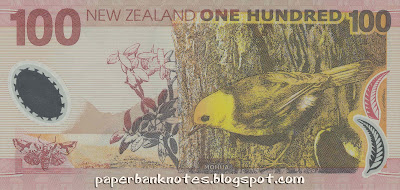
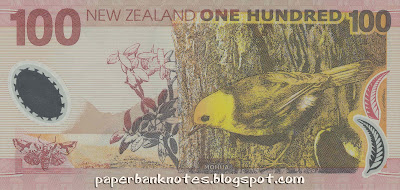
Back - The theme on the back is the Beech Forest scene. The Beech Forest covers more than 2.9 million hectares of land in New Zealand, which can be found mainly in the mountains in the North Island and in the western part of the South Island. The Yellowhead (Mohua) bird is also depicted on the note and on the background to the left is the Red Beech, Eglinton Valley in Fiordland National Park, South Island. A Lichen Moth is also featured on the bottom left corner of the note too.
 
Dimensions - 155mm x 74mm

Yellowhead (Mohua) bird

Certificate of Authenticity and Information Cover
 
Footnote: -
Below are the details of New Zealand 6th and 7th series annual Collector's sets issued from 1999 to 2016 by the Reserve Bank of New Zealand. These are all polymer series of banknotes and only issued for 9 years. Whilst these are numismatic products, not all notes sold in this format were released to the public for normal circulation. The only way to get the banknote with the particular year is to get the annual collector's sets. All annual sets were limited to 1000 sets only. The first set was issued in 1999 when New Zealand fully converted all banknotes from paper to polymer substrate materials.
 
1999 - 1000 sets limited edition, only 746 sets sold at NZ$240 per set;
2000 - 1000 sets limited edition, only 817 sets sold at NZ$255 per set;
2001 - 1000 sets limited edition, only 491 sets sold at NZ$250 per set;
2002 - 1000 sets limited edition, only 291 sets sold at NZ$270 per set;
2003 - 1000 sets limited edition, only 273 sets sold at NZ$270 per set;
2004 - 1000* sets limited edition, all sold out at NZ$295 per set;
2007 - 1000* sets limited edition, all sold out at NZ$295 per set;
2008 - 1000* sets limited edition, all sold out at NZ$295 per set; and
2016 - 1000 sets limited edition 7th series, all sold out at record time at NZ$295 per set.
 
It is not sure why the sale figures for the 2002 and 2003 sets were so low. Perhaps collectors felt that these were only issued as numismatic products and would not bother to keep buying them for all other years. Or could it be that this was due to poor marketing outside the country or the lack of it. However, the distribution method changed for the sale of the 2004 annual sets and from there onward, all sets were fully sold. It is very unfortunate that all unsold sets from 1999 to 2003 were destroyed by the bank. I am pretty sure that all sets with serial numbers from single digit, right up to no. 100 are all in the collector's hand.

Note * - only 999 sets were put on sale as the Reserve Bank retained one set for their own archive purpose.


...New Zealand - 2002 Annual Polymer Collectors Set Limited Edition of 1000 Sets (Only 291 Sets Sold) S/# AA02 0000098

New Zealand
(Aotearoa)

Reserve Bank of New Zealand (since 1934)
(Te Putea Matua)
Currency : Dollar (NZD)
 
This is a full set of New Zealand banknotes all printed with matching serial numbers. This set was issued in 2002. This is a special issue limited to 1000 sets only. 

New Zealand first introduced polymer banknotes in May 1999 and released its full set of banknotes with denominations of $5, $10, $20, $50 and $100. New Zealand, after Australia, is the second country to have fully converted all of its banknotes from cotton based paper banknotes to polymer. 
 
The main designs of this series are very similar to those last paper banknotes issued. The main designs of this series are very similar to those last paper banknotes issued. The themes for this series are the famous New Zealanders on the front and the natural scenes of New Zealand on the back. However, for the advantage of polymer banknotes, a transparent window is added to all the designs as an additional security feature. All notes are printed with AA first prefix. The serial no for this set is AA02 000098.

This is a limited edition mainly for collection, and was not meant for circulation as the issue price was NZ$270 per set against a face value of NZ$185. This is also the only way to get a full set for the year 2002, as in 2002, only the $10 was issued for general circulation. Despite being a limited edition, I do not believe it was a successful numismatic product issued as out of the 1000 sets printed, only 291 sets were sold. The remaining unsold sets were later destroyed by the bank. I was told that the bank decided to cull those unsold sets as it creates an issue to the bank when it comes to conducting annual internal auditing for its inventory as all items need to be counted and verified, and in order to avoid this the bank decided to destroy all remaining unsold sets. Isn't this sad? The bank could have pushed all remaining unsold sets to dealers at a discounted price. What a waste?

New Zealand first commenced circulating polymer banknotes in May 1999, and had since issued collectors full set limited editions in 1999, 2000, 2001, 2002, 2003, 2004, 2007, 2008 and 2015/16. All sets are issued with 5 notes with the exception of the 2000 set, which also came with the $10 millennium commemorative note. These limited editions are all limited to 1000 sets each. The 1999  polymer banknotes of New Zealand is the sixth series of banknotes since 1934. The 2015/2016 issue is the seventh series.
 
Signature
Governor - Donald Thomas Brash (tenure - 01.09.1988 to 26.04.2002)
 
Five dollars  
nd2002, Sir Edmund Hillary (b.1919-2008)

Front - Main feature is of Sir Edmund Hillary (b.1919-2008). He became world-famous in 1953 when he and his Sherpa, Tenzing Norgay (b.1914-1986) successfully conquered Mount Everest for the first time. To his right is Mount Cook, which is the highest mount in New Zealand. It has a height of 3724 meters and is situated in the middle of the South Island. Below Mount Cook is the image of a Massy Ferguson tractor. This tractor was used in 1955-1958 during the Trans-Antarctic expedition. It is believed that this tractor was driven by Hillary during the expedition.
 
Note: Many years ago, I read somewhere that there was a dispute over who actually reached Mount Everest first. Was it Hillary or Norgay? Some argued that it was Norgay but decided not to take the glory as the first person to reach the summit. However, according to a report that a few years after the successful expedition, it was reported that Norgay revealed that it was Hillary who actually stepped on the summit first. If you search the Internet, the achievement for climbing Mount Everest was accredited to both of them.

Back - The theme of the reverse is the Campbell Island scene. Campbell Island is situated in the southern part of New Zealand, and it is currently uninhabited. A Yellow Eyed penguin which can be found on Campbell Island and many other penguin species as well. The Bulbinella Rossii plant (Lilly) is also featured on the note and can be found on the island, as well as the Pleurophyllum Speciosum plant (daisy) and the Bull Kelp plant as well.

Dimensions - 135mm x 66mm
 
Yellow Eyed penguin
 
Ten Dollars
nd2002, Kate Sheppard (b.1848-1934)

Front - Kate Sheppard (b.1848-1934) was born in Liverpool England and emigrated to New Zealand in 1868. During her lifetime, she was an active member of various religious and social groups. To her right is the White Camellia flower which symbolises the fight for the vote by New Zealand women. The right to vote by women in New Zealand was granted in 1893.
 
Back - On the back, it features the River scene with a pair of Blue ducks (Whio). The Blue duck is special as it can only be founded in New Zealand. The Parahebe Catarractae (a plant, a close relative of the Hebe) and the Blechnum Fern (a common fern found throughout New Zealand) are also featured on the background of the note.
 
Dimensions - 140mm x 68mm
 
A pair of Blue duck (Whio)
 
Twenty Dollars
nd2002, Queen Elizabeth The Second

Front - The portrait of Queen Elizabeth the Second (b.1926-). This portrait was taken by Ronald Woolf in 1986 when the Queen was 60 years old. Next to her is the New Zealand Parliament buildings located in Wellington, the Capital city of New Zealand.

Back - On the back is the Alpine scene of New Zealand, mainly located on the southern island. The main feature of this note is the New Zealand falcon (Karearea). Next to it is the Marlbourough Rock daisy, and on the background is Mount Tapuaenuku (Tapuae-o-Uenuku). This mountain is 2,885 meters tall and is the highest peak in the northeast of New Zealand's South Island.
 
Dimensions - 145mm x 70mm

New Zealand falcon (Karearea)
 
Fifty Dollars
nd2002, Sir Apirana Ngata (b.1874-1950)

Front - Sir Apirana Ngata (b.1874-1950) was a Maori politician. During his lifetime, he served as the Minister of Native Affairs between 1928 and 1934. A Pourourangi Meeting House at Waiomatatini Marae near Ruatoria, which Sir Ngata helped to construct during his lifetime. The Meeting Houses were constructed to promote Maori culture and Maori sports.
 
Back - On the back is the Conifer Broadleaf Forest scene which can be found through New Zealand. A Blue Wattled Crow is the main feature on the back of the note. The Pureora Forest Supplejack is also featured on the background and Sky-Blue Mushrooms are also depicted to the right-side of the note.
 
Dimensions - 150mm x 72mm

A Blue Wattled Crow
 
One Hundred Dollars
nd2002, Ernest Lord Rutherford of Nelson (b.1871-1937)

Front - Ernest Lord Rutherford of Nelson (b.1871-1937), a physicist and was known to be the father of nuclear physics. In 1908, he was awarded the Nobel Prize in Chemistry (Nobel Prize Medallion for Chemistry and graph depicted on the left).
 
Back - The theme on the back is the Beech Forest scene. The Beech Forest covers more than 2.9 million hectares of land in New Zealand, which can be found mainly in the mountains in the North Island and in the western part of the South Island. The Yellowhead (Mohua) bird is also depicted on the note and on the background to the left is the Red Beech, Eglinton Valley in Fiordland National Park, South Island. A Lichen Moth is also featured on the bottom left corner of the note too.
 
Dimensions - 155mm x 74mm

Yellowhead (Mohua) bird
 
Certificate of Authenticity and Information Cover

Footnote: -
Below are the details of New Zealand 6th and 7th series annual Collector's sets issued from 1999 to 2016 by the Reserve Bank of New Zealand. These are all polymer series of banknotes and only issued for 9 years. Whilst these are numismatic products, not all notes sold in this format were released to the public for normal circulation. The only way to get the banknote with the particular year is to get the annual collector's sets. All annual sets were limited to 1000 sets only. The first set was issued in 1999 when New Zealand fully converted all banknotes from paper to polymer substrate materials.
 
1999 - 1000 sets limited edition, only 746 sets sold at NZ$240 per set;
2000 - 1000 sets limited edition, only 817 sets sold at NZ$255 per set;
2001 - 1000 sets limited edition, only 491 sets sold at NZ$250 per set;
2002 - 1000 sets limited edition, only 291 sets sold at NZ$270 per set;
2003 - 1000 sets limited edition, only 273 sets sold at NZ$270 per set;
2004 - 1000* sets limited edition, all sold out at NZ$295 per set;
2007 - 1000* sets limited edition, all sold out at NZ$295 per set;
2008 - 1000* sets limited edition, all sold out at NZ$295 per set; and
2016 - 1000 sets limited edition 7th series, all sold out at record time at NZ$295 per set.
 
It is not sure why the sale figures for the 2002 and 2003 sets were so low. Perhaps collectors felt that these were only issued as numismatic products and would not bother to keep buying them for all other years. Or could it be that this was due to poor marketing outside the country or the lack of it. However, the distribution method changed for the sale of the 2004 annual sets and from there onward, all sets were fully sold. It is very unfortunate that all unsold sets from 1999 to 2003 were destroyed by the bank. I am pretty sure that all sets with serial numbers from single digit, right up to no. 100 are all in the collector's hand.

Note * - only 999 sets were put on sale as the Reserve Bank retained one set for their own archive purpose.


...New Zealand - 2001 Annual Polymer Collectors Set Limited Edition of 1000 Sets (Only 491 Sets Sold) S/# AA01 0000098

 New Zealand
(Aotearoa)

Reserve Bank of New Zealand (since 1934)
(Te Putea Matua)
Currency : Dollar (NZD)
 
This is a full set of New Zealand banknotes all printed with matching serial numbers. This set was issued in 2001. This is a special issue limited to 1000 sets only. 

New Zealand first introduced polymer banknotes in May 1999 and released its full set of banknotes with denominations of $5, $10, $20, $50 and $100. New Zealand, after Australia, is the second country to have fully converted all of its banknotes from cotton based paper banknotes to polymer. 
 
The main designs of this series are very similar to those last paper banknotes issued. The main designs of this series are very similar to those last paper banknotes issued. The themes for this series are the famous New Zealanders on the front and the natural scenes of New Zealand on the back. However, for the advantage of polymer banknotes, a transparent window is added to all the designs as an additional security feature. All notes are printed with AA first prefix. The serial no for this set is AA01 000098.

This is a limited edition mainly for collection, and was not meant for circulation as the issue price was NZ$250 per set against a face value of NZ$185. This is also the only way to get a full set for the year 2000, as in 2001, no banknote was issued for general circulation. Despite this being a limited edition, I do not believe it was a successful numismatic product issued as out of the 1000 sets printed, only 491 sets were sold. The remaining unsold sets were later destroyed by the bank. I was told that the bank decided to cull those unsold sets as it creates an issue to the bank when it comes to conducting annual internal auditing for its inventory as all items need to be counted and verified, and in order to avoid this the bank decided to destroy all remaining unsold sets. Isn't this sad? The bank could have pushed all remaining unsold sets to dealers at a discounted price. What a waste?

New Zealand first commenced circulating polymer banknotes in May 1999, and had since issued collectors full set limited editions in 1999, 2000, 2001, 2002, 2003, 2004, 2007, 2008 and 2015/16. All sets are issued with 5 notes with the exception of the 2000 set, which also came with the $10 millennium commemorative note. These limited editions are all limited to 1000 sets each. The 1999  polymer banknotes of New Zealand is the sixth series of banknotes since 1934. The 2015/2016 issue is the seventh series.
 
Signature
Governor - Donald Thomas Brash (tenure - 01.09.1988 to 26.04.2002)
 
Five dollars
nd2001, Sir Edmund Hillary (b.1919-2008)

Front - Main feature is of Sir Edmund Hillary (b.1919-2008). He became world-famous in 1953 when he and his Sherpa, Tenzing Norgay (b.1914-1986) successfully conquered Mount Everest for the first time. To his right is Mount Cook, which is the highest mount in New Zealand. It has a height of 3724 meters and is situated in the middle of the South Island. Below Mount Cook is the image of a Massy Ferguson tractor. This tractor was used in 1955-1958 during the Trans-Antarctic expedition. It is believed that this tractor was driven by Hillary during the expedition.
 
Note: Many years ago, I read somewhere that there was a dispute over who actually reached Mount Everest first. Was it Hillary or Norgay? Some argued that it was Norgay but decided not to take the glory as the first person to reach the summit. However, according to a report that a few years after the successful expedition, it was reported that Norgay revealed that it was Hillary who actually stepped on the summit first. If you search the Internet, the achievement for climbing Mount Everest was accredited to both of them.

Back - The theme of the reverse is the Campbell Island scene. Campbell Island is situated in the southern part of New Zealand, and it is currently uninhabited. A Yellow Eyed penguin which can be found on Campbell Island and many other penguin species as well. The Bulbinella Rossii plant (Lilly) is also featured on the note and can be found on the island, as well as the Pleurophyllum Speciosum plant (daisy) and the Bull Kelp plant as well.

Dimensions - 135mm x 66mm
 
Yellow Eyed penguin
 
Ten Dollars
nd2001, Kate Sheppard (b.1848-1934)

Front - Kate Sheppard (b.1848-1934) was born in Liverpool England and emigrated to New Zealand in 1868. During her lifetime, she was an active member of various religious and social groups. To her right is the White Camellia flower which symbolises the fight for the vote by New Zealand women. The right to vote by women in New Zealand was granted in 1893.
 
Back - On the back, it features the River scene with a pair of Blue ducks (Whio). The Blue duck is special as it can only be founded in New Zealand. The Parahebe Catarractae (a plant, a close relative of the Hebe) and the Blechnum Fern (a common fern found throughout New Zealand) are also featured on the background of the note.
 
Dimensions - 140mm x 68mm

A pair of Blue duck (Whio)
 
Twenty Dollars
nd2001, Queen Elizabeth The Second

Front - The portrait of Queen Elizabeth the Second (b.1926-). This portrait was taken by Ronald Woolf in 1986 when the Queen was 60 years old. Next to her is the New Zealand Parliament buildings located in Wellington, the Capital city of New Zealand.

Back - On the back is the Alpine scene of New Zealand, mainly located on the southern island. The main feature of this note is the New Zealand falcon (Karearea). Next to it is the Marlbourough Rock daisy, and on the background is Mount Tapuaenuku (Tapuae-o-Uenuku). This mountain is 2,885 meters tall and is the highest peak in the northeast of New Zealand's South Island.
 
Dimensions - 145mm x 70mm

New Zealand falcon (Karearea)
 
Fifty Dollars
nd2001, Sir Apirana Ngata (b.1874-1950)
 
Front - Sir Apirana Ngata (b.1874-1950) was a Maori politician. During his lifetime, he served as the Minister of Native Affairs between 1928 and 1934. A Pourourangi Meeting House at Waiomatatini Marae near Ruatoria, which Sir Ngata helped to construct during his lifetime. The Meeting Houses were constructed to promote Maori culture and Maori sports.
 
Back - On the back is the Conifer Broadleaf Forest scene which can be found through New Zealand. A Blue Wattled Crow is the main feature on the back of the note. The Pureora Forest Supplejack is also featured on the background and Sky-Blue Mushrooms are also depicted to the right-side of the note.
 
Dimensions - 150mm x 72mm

A Blue Wattled Crow
 
One Hundred Dollars
nd2001, Ernest Lord Rutherford of Nelson (b.1871-1937)

Front - Ernest Lord Rutherford of Nelson (b.1871-1937), a physicist and was known to be the father of nuclear physics. In 1908, he was awarded the Nobel Prize in Chemistry (Nobel Prize Medallion for Chemistry and graph depicted on the left).
 
Back - The theme on the back is the Beech Forest scene. The Beech Forest covers more than 2.9 million hectares of land in New Zealand, which can be found mainly in the mountains in the North Island and in the western part of the South Island. The Yellowhead (Mohua) bird is also depicted on the note and on the background to the left is the Red Beech, Eglinton Valley in Fiordland National Park, South Island. A Lichen Moth is also featured on the bottom left corner of the note too.
 
Dimensions - 155mm x 74mm

Yellowhead (Mohua) bird

Brief descriptions of all the banknotes

  
Front cover

 
Footnote: -
Below are the details of New Zealand 6th and 7th series annual Collector's sets issued from 1999 to 2016 by the Reserve Bank of New Zealand. These are all polymer series of banknotes and only issued for 9 years. Whilst these are numismatic products, not all notes sold in this format were released to the public for normal circulation. The only way to get the banknote with the particular year is to get the annual collector's sets. All annual sets were limited to 1000 sets only. The first set was issued in 1999 when New Zealand fully converted all banknotes from paper to polymer substrate materials.
 
1999 - 1000 sets limited edition, only 746 sets sold at NZ$240 per set;
2000 - 1000 sets limited edition, only 817 sets sold at NZ$255 per set;
2001 - 1000 sets limited edition, only 491 sets sold at NZ$250 per set;
2002 - 1000 sets limited edition, only 291 sets sold at NZ$270 per set;
2003 - 1000 sets limited edition, only 273 sets sold at NZ$270 per set;
2004 - 1000* sets limited edition, all sold out at NZ$295 per set;
2007 - 1000* sets limited edition, all sold out at NZ$295 per set;
2008 - 1000* sets limited edition, all sold out at NZ$295 per set; and
2016 - 1000 sets limited edition 7th series, all sold out at record time at NZ$295 per set.
 
It is not sure why the sale figures for the 2002 and 2003 sets were so low. Perhaps collectors felt that these were only issued as numismatic products and would not bother to keep buying them for all other years. Or could it be that this was due to poor marketing outside the country or the lack of it. However, the distribution method changed for the sale of the 2004 annual sets and from there onward, all sets were fully sold. It is very unfortunate that all unsold sets from 1999 to 2003 were destroyed by the bank. I am pretty sure that all sets with serial numbers from single digit, right up to no. 100 are all in the collector's hand.

Note * - only 999 sets were put on sale as the Reserve Bank retained one set for their own archive purpose.